

Written by Jamie Hreniuk, DPT
Article
 If you’ve been told you have foot drop, you may notice your toes catching the ground, difficulty clearing your foot when walking, or feeling like you need to lift your leg higher just to avoid tripping. That can feel frustrating — and sometimes frightening.
But here’s what’s important to know: foot drop is a symptom, not a diagnosis. And with the right support, there are effective ways to manage it and keep moving with confidence.
At HARTZ PT NeuroRehabilitation, we help people with foot drop every day — combining movement retraining, strength and balance work, and close collaboration with local orthotists to find the right solution for each person.
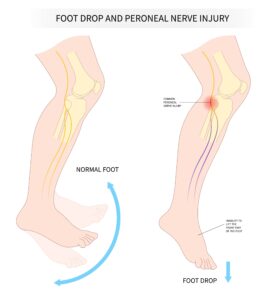 What Is Foot Drop?
Foot drop occurs when the muscles that lift the front of the foot — called dorsiflexors — are weak, slow to activate, or not receiving clear signals from the nervous system. This causes the foot to drag or slap during walking and increases the risk of falls.
To compensate, many people unconsciously adapt their gait by:
- Lifting the knee higher than normal (“steppage gait”)
- Swinging the leg outward
- Shortening their stride
- Avoiding uneven surfaces or stairs
Over time, these compensations can lead to fatigue, joint pain, and reduced confidence — which is why addressing foot drop early matters.
What Causes Foot Drop?
Foot drop can have many different origins, including:
- Stroke
- Peripheral Neuropathy
- Multiple Sclerosis
- Parkinson’s Disease
- Brain or Spinal Cord Injury
- Nerve Compression or Injury
- Post-Surgical Nerve Involvement
- Muscle weakness after prolonged illness or immobility
Because the cause varies so much from person to person, treatment is never one-size-fits-all — and it shouldn’t be.
How Physical Therapy Helps
Neuro physical therapy focuses on improving how the brain, nerves, and muscles work together during walking — not just strengthening one muscle in isolation.
Depending on your needs, treatment may include:
- Gait training
- Strengthening and motor control exercises
- Balance training to reduce fall risk
- Stretching and tone management
- Task-specific practice on stairs, uneven surfaces, and turns
- Functional Electrical Stimulation (FES), which uses gentle electrical pulses to stimulate the muscles that lift the foot during walking
- Education on energy conservation and safe mobility strategies
The goal is always to help you move more safely, efficiently, and independently in your real life.
When Is Bracing Helpful?
An ankle-foot orthosis (AFO) may be recommended when:
- The foot cannot clear the ground safely during walking
- Fatigue worsens foot control later in the day
- There is a high risk of tripping or falling
- Compensatory movements are causing pain or inefficiency
- Safety and independence are being limited
Bracing is not a failure — it’s often a tool that allows you to walk more safely and confidently while continuing to make progress in therapy.
Why the Right Brace Matters
Not all braces are created equal. The best option for you depends on a number of factors:
- Your strength and muscle activation
- Presence of tone or spasticity
- Balance and stability needs
- Endurance and walking goals
- Footwear preferences
- Daily activities — work, community mobility, uneven terrain
A brace that is too rigid, too flexible, or poorly fitted can limit your progress — or even create new problems. That’s why we don’t approach this in isolation.
At HARTZNeuroRehabilitation, we work closely with local orthotists to make sure each patient gets the most appropriate option, not just the most common one. This team-based approach allows us to trial different brace styles during therapy, assess how a device affects gait and efficiency, and reassess as your strength and mobility change over time.
You Don’t Have to Navigate This Alone
Foot drop can affect your confidence, your independence, and your quality of life — but improvement is possible with the right support.
If you or a loved one is experiencing foot drop, or wondering whether therapy or bracing could help, we’d love to talk through your options.
Contact us here at 717.735.8880 — we’re here to help you move forward.