

Pain when running: what to do?
Picture this: a runner signed up for a fall marathon last spring and started a training plan three months ago, building their long run each week. This weekend, during a 22-mile run, their knee starts to feel sore around mile 14. They panic. Is all that training about to go to waste? Now every step becomes an analysis of that knee.
We’ve all been there. You feel a twinge, your mind starts racing, and you can’t stop thinking about it. Should you stop? Push through? Will it get worse?
The answer depends on the runner and the situation. I’d respond differently to something I felt in the closing miles of a half marathon than during an off-season easy run. But in the moment, these five questions can help guide your decision:1-2
- How bad is the pain (0-10), and is it sharp or just tight/sore?
- Does it change my running (limping, altered stride, slowing down)?
- Does it get worse the longer I run, or ease up as I warm up?
- Does it linger after I stop, into the rest of my day or the next morning?
- Is there visible swelling, or a specific spot that hurts to press?
I use a traffic light system to interpret the answers.
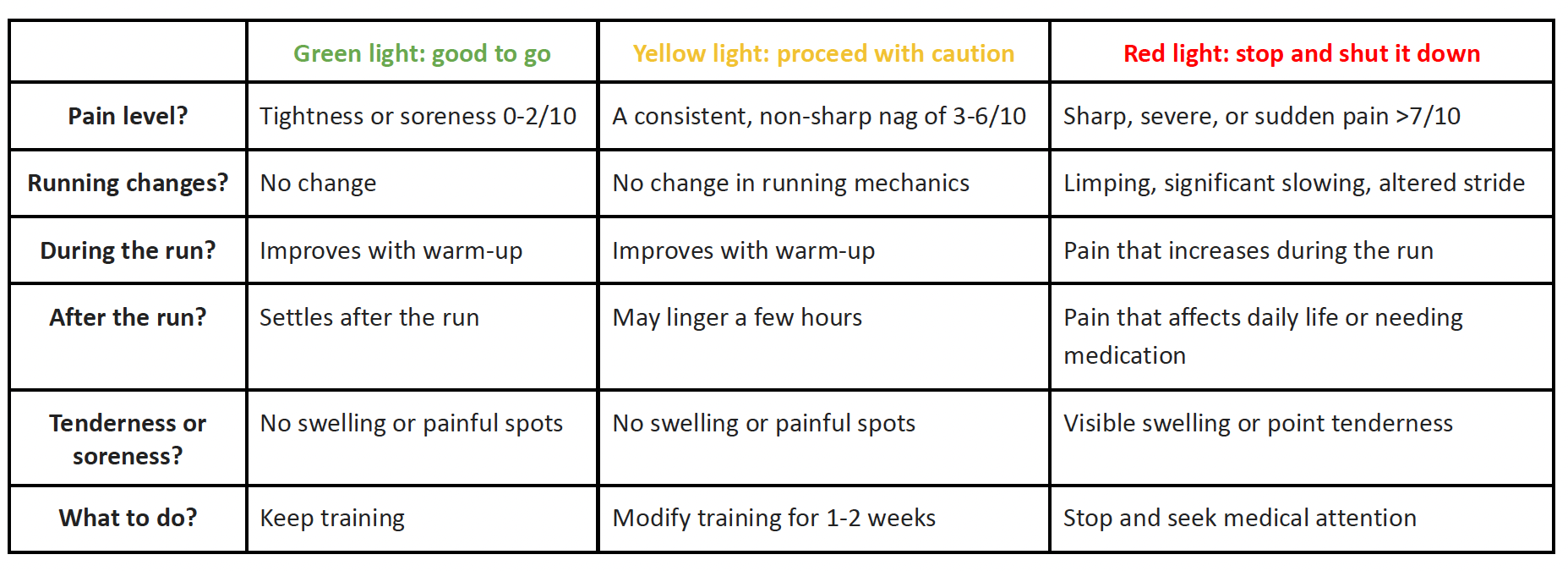
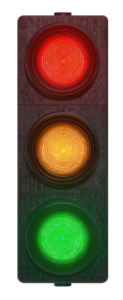 Red seems obvious, but many athletes feel pressure to prove their toughness by pushing through training or finishing a race. Those short-term “gains” aren’t worth the long-term consequences. If you’re in the red zone, seek medical attention quickly.
Yellow is trickier. Most runners here just need to modify training for a week or two and let things settle. That might mean reducing volume, intensity, frequency, duration, or vertical gain.1-2 If you’re in the yellow and unsure what to change, reach out, and I’d love to help.
Green is a normal training response. Tightness and soreness often follow hard sessions and are usually benign.1-2
So what should our runner who feels some knee pain at mile 14 do? If the discomfort eases and doesn’t change their stride, they should continue, but if it increases as they go and/or changes their stride, they should stop, walk, and reassess over the next couple of days. If it continues to bother him over the coming weeks, get it checked out.
Missing a session or even time off doesn’t hurt your training as much as you think!
Missing a session is not going to hurt your fitness as much as trying to cram the session into later in the week and blunting recovery. Even if life gets busy and you have to reduce training, you can still maintain your fitness with 50% of your normal volume as long as you maintain the intensity in the sessions that you can get.3 Don’t stress missing a session. Simply pick up with the next one, and if you have a few busy weeks, maintain your intensity (quality sessions) to maintain your fitness.
Skipping
It’s just marching with a little hop! Skipping is a great way to work on knee drive, posture, and power needed when running.
Try it: March in place • Add a little hop while marching • Keep your chest tall • Move your arms naturally • Start moving forward. Use it as a warm-up. Try 3-4 rounds of 10 yards before you run.
Get one running email a month
Evidence-based, no hype, no spam. Join runners getting Fuel for Your Run in their inbox.
Want to learn more?
Have a running question you’d like me to cover in a future edition of Fuel for Your Run? Reach out any time. Until next month — keep running.
 Noah Esbenshade, DPT, COMT, CSCS is a physical therapist, certified strength and conditioning coach, running coach, and running gait analyst at HARTZ Physical Therapy. A triathlete himself, he started Fuel for Your Run to share research-backed tips and help runners make sense of the advice they see online. You may email him at nesbenshade@hartzpt.com.
References
- Larson P, Higgins E, Kaminski J, et al. Foot strike patterns of recreational and sub-elite runners in a long-distance road race. Journal of Sports Sciences. 2011.
- Kasmer ME, Liu XC, Roberts KG, Valadao JM. Foot-strike pattern and performance in a marathon. International Journal of Sports Physiology and Performance. 2013.
- Hanley B, Bissas A, Merlino S, Gruber AH. Most marathon runners at the 2017 IAAF World Championships were rearfoot strikers, and most did not change footstrike pattern. Journal of Biomechanics. 2019.
- Nishiguchi H, Takabayashi T, Kikumoto T, Kubo M. Effects of foot-strike patterns during running on cumulative load of Achilles tendon force, plantar fascia force, and patellofemoral joint stress. Journal of Sports Science & Medicine. 2025.
- Han S, Moon J, Lee J, et al. Influence of manipulating running foot strike angle on internal loading of the tibia. Scandinavian Journal of Medicine & Science in Sports. 2025.
- Van Hooren B, Jukic I, Cox M, et al. The relationship between running biomechanics and running economy: a systematic review and meta-analysis of observational studies. Sports Medicine. 2024.