

Article
bladder, incontinence, Pelvic Health, Pelvic Pain
Meet Your Pelvic Floor
When most people picture physical therapy, they think of a torn ACL, a new knee, or that lower back that’s been barking for months. What they don’t picture is the group of muscles quietly running some of the body’s most important daily jobs — the ones that almost never get any attention until something starts to go wrong. We’re talking about your pelvic floor.
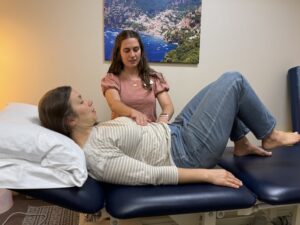
 Here’s a simple way to picture it — and this photo to the left is a decent head start. Imagine a supportive hammock made of muscle and ligament, stretched across the base of your pelvis. That hammock is the foundation holding up your bladder, your bowels, and your reproductive organs — keeping everything where it belongs and giving you a say in when you head to the restroom.
And just like any other muscle in your body, your pelvic floor can get weak, too tight, strained, or a little uncoordinated. When that happens, the symptoms can be frustrating, uncomfortable, and — because so few people talk about them — surprisingly isolating. But you’re far from alone, and this is a lot more fixable than you might think.
Two Signs Your Pelvic Floor Could Use Some Attention
Most people who come to us for pelvic floor help are dealing with one of two things. Let’s walk through both.
1. Unwanted Bladder Leaks (Urinary Incontinence)
Millions of adults live with bladder leakage, quietly assuming it’s just part of getting older or the permanent “new normal” after having kids. Here’s the truth: it’s a highly treatable muscular issue. It usually falls into one of two buckets:
Stress incontinence happens when physical force pushes down on the bladder. If your pelvic floor muscles aren’t strong enough to hold up against that pressure, everyday moments — a good laugh, a cough, a sneeze, a jump on the trampoline with your kids — can trigger a leak.
Urge incontinence is that sudden, gotta-go-right-now feeling, often tied to an overactive bladder. It’s frequently set off by little environmental cues: hearing water run, turning your key in the front door, or a sudden drop in temperature — any of which can make the bladder muscle spasm before you’re ready.
2. Persistent Pelvic Pain
Your pelvis is built from three bones that meet at three separate joints, and your pelvic floor muscles help keep those joints stable. So when those muscles are off, pain can follow.
When the muscles are too tight, they create excess compression — pulling on the joints and nearby nerves and leaving you with deep, aching, or sharp pain. When they’re too loose, the joints lose support and start to shift under shear forces, which can lead to localized inflammation and instability.
 How Pelvic Floor Physical Therapy Helps
Because these issues are muscular at their core, they tend to respond really well to targeted physical therapy — and that’s where we come in. As movement experts, we look at your whole system, not just one piece of it, and build a plan around you. Your treatment might include:
- Targeted muscle training. If your muscles are weak, we focus on coordination and strengthening. If they’re chronically tight, we teach you how to consciously relax and lengthen them.
- Biofeedback therapy. Using gentle sensors, biofeedback gives you a real-time read-out of what your muscles are doing. It helps you learn exactly which muscles are firing and when they’re letting go — which is a game-changer when you’re retraining them.
- Hands-on manual therapy. We use precise, gentle techniques like myofascial release, soft tissue mobilization, and trigger point therapy to calm painful spasms, ease tension, and get healthy blood flow moving through the area again.
- Lifestyle and habit coaching. We look at the bigger picture, too. Small tweaks to your posture, how you sit and stand, your fluid intake, and even your breathing can take a surprising amount of pressure off your bladder and pelvic joints.
Take Back Control
Here’s what we most want you to hear: you don’t have to just live with pelvic discomfort or bladder leaks, and you don’t have to feel awkward about wanting help. These are common, treatable issues — and getting to the bottom of them is exactly what we do.
At our Ephrata office, Celia Vallie, DPT, our pelvic floor therapist specializes in exactly this kind of care. You can learn more about how we can help on our pelvic health page, and in Pennsylvania, you don’t even need a doctor’s referral to get started. Just call our Ephrata office at 717.738.0004 and Celia will be glad to talk through what you’re experiencing and get you scheduled. A comprehensive evaluation can find the root cause and help you get back to a life of confidence, comfort, and control.
Sources & Additional Reading
● Urinary Incontinence in the Elderly: A Review of the Recent Literature
● Physical Therapy Assessment of Pelvic Floor Muscle Function
● Pediatric Pelvic Floor Dysfunction and Physical Therapy Management
● The Role of Physical Therapists in Pelvic Floor Rehabilitation
● Prevalence and Trends of Urinary Incontinence Among Female CrossFitters
● Pelvic Floor Muscle Training for the Treatment of Urinary Incontinence
● The Impact of Exercise During Pregnancy on Pelvic Floor Health