
Written by David Snyder, DPT, CSCS
Article
Back pain, Health & Wellness, Sports
Back Pain in Teens??? Spondy What?
When most people think about back pain, they picture adults hunched over desks or seniors dealing with decades of wear and tear. But back pain in teenagers? It’s more common than you might think — and for young athletes, it can be a real game-changer if left unaddressed.
Adolescents, particularly those who play sports, can experience significant low back pain. This is especially true for athletes involved in activities that demand repetitive forceful extension or rotation of the spine — think gymnastics, baseball, softball, football, and dance. Two of the most common culprits behind this kind of pain are conditions called spondylolysis and spondylolisthesis. These terms might sound intimidating, but understanding what they mean can help you take better care of your teen athlete.
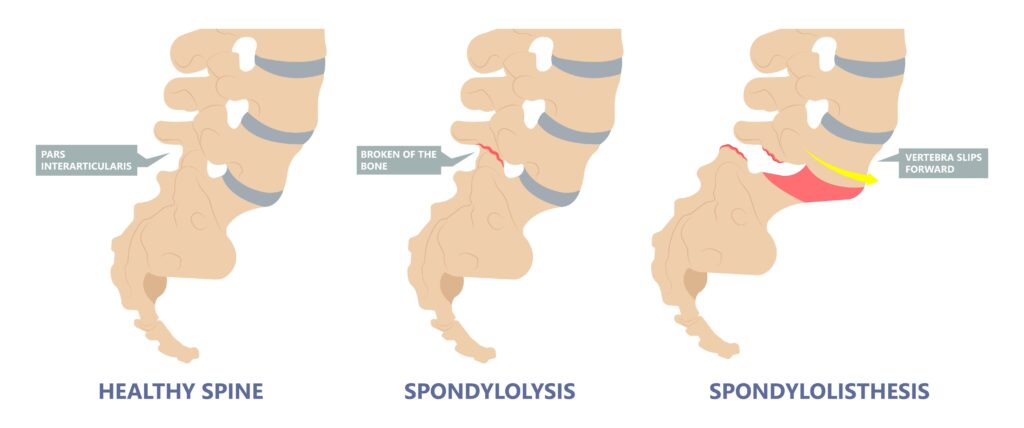 Spondylolysis vs. Spondylolisthesis: What’s the Difference?
These two conditions are related, but they are not the same thing. Here’s a simple breakdown:
Spondylolysis is essentially a stress fracture in one of the vertebrae of the lower spine. Rather than resulting from a single traumatic event, it develops gradually over time from repeated movements like arching or bending the back — exactly the kind of movements young gymnasts and pitchers make hundreds of times a week. Because it builds up slowly, many teens don’t even realize something is wrong until the pain becomes hard to ignore.
Key things to know about spondylolysis: it’s very common in active teenagers, the vertebrae remain in their normal position (no slipping), pain may come and go or be absent altogether, and it is often the earliest stage of a broader problem.
Spondylolisthesis occurs when things progress a step further. If stress fractures develop on both sides of the vertebra, the bone can begin to shift — sliding forward over the vertebra beneath it. This slippage is what defines spondylolisthesis, and it tends to be more symptomatic than spondylolysis alone.
Key things to know about spondylolisthesis: it is less common than spondylolysis, it is more likely to cause ongoing or persistent pain, symptoms can include leg pain or unusually tight hamstring muscles, and the severity of symptoms depends on how far the bone has slipped.
How Is It Diagnosed?
If your teen is complaining of low back pain that won’t go away — especially pain that gets worse with activity or bending backward — it’s worth getting it checked out. A doctor will typically take a detailed history, perform a physical exam, and order imaging such as X-rays or an MRI to get a clear picture of what’s happening in the spine.
One hallmark sign that often prompts further investigation is pain that worsens when your teen arches their back or stands on one leg while leaning backward — a movement sometimes called the “stork test.” If your child’s doctor suspects spondylolysis or spondylolisthesis, imaging will help confirm the diagnosis and determine the severity.
What Does Treatment Look Like?
The good news is that the vast majority of teens with spondylolysis or spondylolisthesis do not need surgery. Treatment is focused on giving the spine a chance to heal while building the strength and flexibility needed to prevent future problems. This typically involves:
Rest from the aggravating activity. This doesn’t necessarily mean your teen has to give up their sport forever — but it does mean taking a step back while the injury heals. Continuing to push through the pain can make things significantly worse and potentially turn a manageable stress fracture into a more serious problem.
Physical therapy. A structured PT program is a cornerstone of recovery. Therapy focuses on improving core strength, increasing flexibility (particularly in the hips and hamstrings), and correcting movement patterns that may have contributed to the injury in the first place. A good physical therapist will also work closely with your teen’s coach to ensure a safe return to training.
Gradual return to sport. Once pain has resolved and strength has improved, your teen can work with their physical therapist and physician to safely return to their sport — often stronger and more body-aware than before. Rushing this process is one of the most common mistakes families make, so patience is key.
Bracing. In some cases, a doctor may recommend a back brace to help offload the injured area and promote healing, particularly in the early stages of recovery or for more severe cases.
When Should You See a Doctor?
Not every ache and pain in a teenager requires a doctor visit, but there are specific warning signs that should prompt you to seek medical attention sooner rather than later. Reach out to a healthcare provider if your teen experiences any of the following:
Low back pain that has lasted more than two to three weeks and isn’t improving with rest. Pain that gets noticeably worse with physical activity, especially arching or extending the back. Pain that radiates down one or both legs, into the buttocks, or causes numbness or tingling. Unusually tight hamstrings that don’t seem to loosen up with stretching. A change in posture, such as a noticeable forward lean or difficulty standing up straight. Pain that is waking your teen up at night.
Early diagnosis makes a significant difference in recovery time and outcomes, so don’t hesitate to get it checked out. What seems like routine soreness could be something that benefits from targeted treatment.
Prevention Tips for Teen Athletes and Coaches
While spondylolysis and spondylolisthesis can’t always be prevented — especially in sports that inherently stress the spine — there are steps athletes, parents, and coaches can take to reduce risk:
Prioritize core strength year-round. A strong core acts like a natural brace for the spine, absorbing forces that would otherwise be transferred directly to the vertebrae. Incorporate core conditioning as a regular part of your athlete’s training program, not just during the season.
Don’t skip rest days. Overtraining is one of the biggest risk factors for stress fractures of all kinds, including spondylolysis. Building in adequate rest and recovery time — both within the week and across the season — gives the body time to repair micro-damage before it becomes a bigger problem.
Monitor training load carefully. Rapid increases in training volume or intensity, especially at the start of a new season, dramatically increase injury risk. Coaches and parents should watch for sudden jumps in practice hours or repetitions, particularly for movements that load the lower back.
Teach and reinforce proper technique. Many back injuries in young athletes stem from faulty movement mechanics. Investing in good coaching that emphasizes proper form — whether that’s a gymnast’s back walkover or a pitcher’s throwing motion — can pay dividends in injury prevention.
Listen to your athlete. Teen athletes are notorious for playing through pain, either because they don’t want to let their team down or because they fear losing their spot. Create an environment where your child feels safe reporting pain early, before a minor issue becomes a major one.
Frequently Asked Questions
Can my teen keep playing their sport while being treated? In most cases, no — at least not right away. Rest from the aggravating activity is a key part of healing. However, the goal of treatment is always to get your athlete back to their sport safely, and most teens are able to return to full activity with proper care.
How long does recovery take? Recovery time varies depending on the severity of the condition. Spondylolysis without slippage often resolves within three to six months with conservative treatment. Spondylolisthesis may take longer, particularly if there is significant slippage involved.
Will my teen need surgery? Surgery is rarely needed and is typically only considered when conservative treatment has failed over an extended period, or when there is significant nerve involvement. The vast majority of teens recover fully without surgical intervention.
Can this happen again after recovery? It’s possible, particularly if the athlete returns to the same sport and the underlying risk factors aren’t addressed. This is why physical therapy focuses not just on healing the injury but on building the strength and movement patterns needed to protect the spine long-term.
Is it safe for my teen to lift weights with this condition? This depends on the severity and stage of healing. Your physical therapist and physician will provide specific guidance, but generally speaking, heavy or unsupported loading of the spine is avoided early in recovery. Controlled, therapeutic strengthening exercises are introduced gradually as healing progresses.